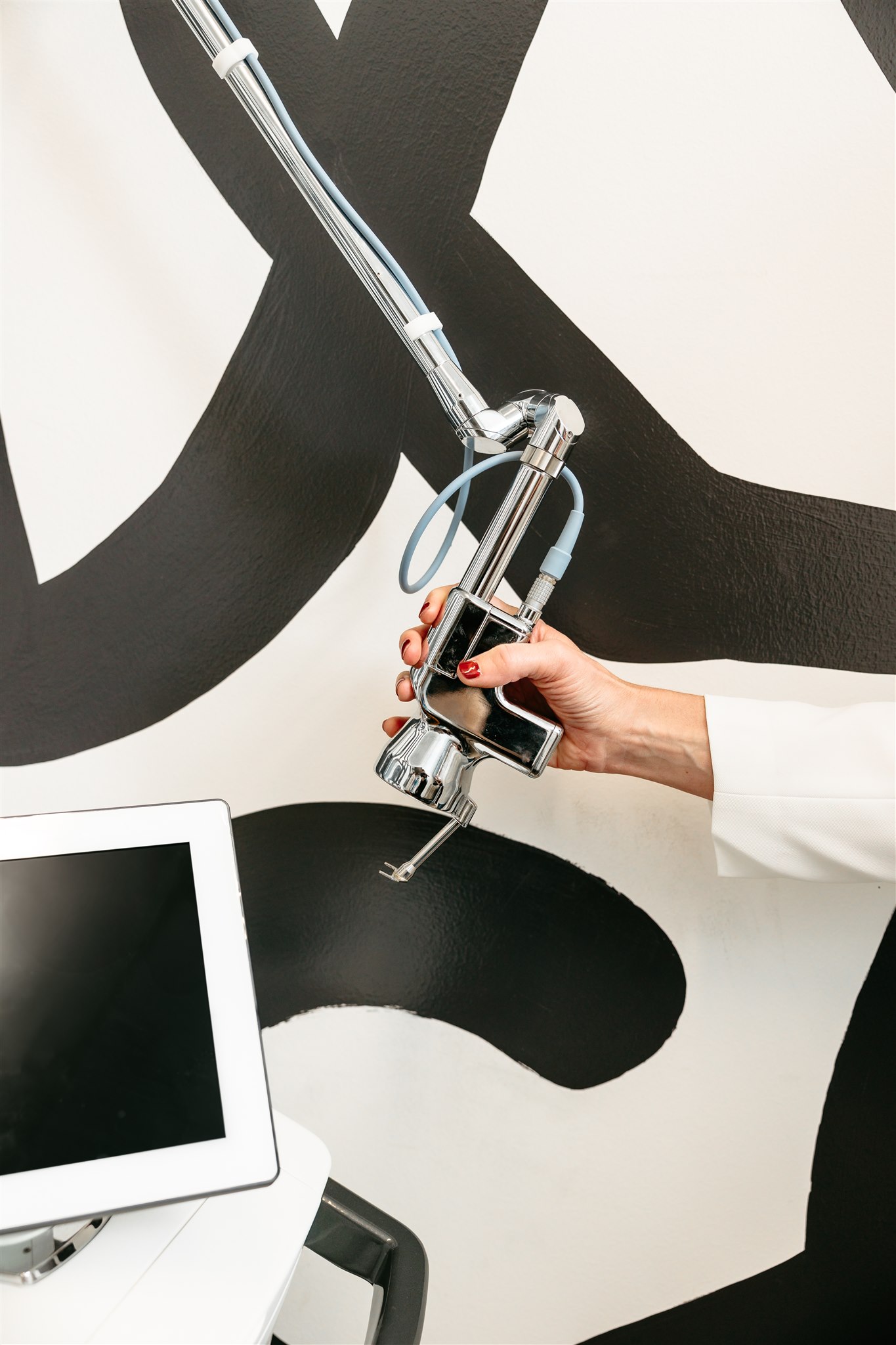
HALO® TRIBRID™ vs HALO®: What's the Difference?
A modern Fort Worth guide to understanding the difference between HALO TRIBRID and HALO — how each treatment works, which concerns each may address, and how to choose based on your skin, not the marketing.
 Amy Robbins, MSNA APRN CRNA FNP-BC 18 min read June 2026Laser & Light
Quick Answer
What is the difference between HALO and HALO TRIBRID?
HALO and HALO TRIBRID are not simply two names for the same treatment. Traditional HALO is a hybrid fractional laser platform that combines two wavelengths — an ablative erbium (2940 nm) and a non-ablative depth component (1470 nm) — within a single treatment. HALO TRIBRID expands the concept by combining three complementary wavelengths (2940 nm, 1927 nm, and 1470 nm) on the Sciton JOULE X platform, adding the 1927 nm MOXI wavelength for superficial tone and pigment. The practical difference is greater treatment flexibility — but the right approach still depends on the patient's skin, goals, treatment intensity, and provider assessment.
Neither is universally better — the right choice depends on your anatomy, skin condition, and goals.
Side by Side
HALO vs HALO TRIBRID
at a glance.
| Feature | HALO | HALO TRIBRID |
|---|---|---|
| Platform approach | Hybrid fractional treatment (two wavelengths) | Three-part / triple-wavelength treatment approach |
| Wavelengths | 2940 nm + 1470 nm | 2940 nm + 1927 nm + 1470 nm |
| Treatment customization | Customizable depth and density | Expanded customization across three wavelengths |
| Skin concerns | Depends on treatment plan | Depends on treatment plan |
| Resurfacing intensity | Customizable | Customizable |
| Downtime | Depends on treatment intensity | Depends on treatment configuration |
| Best candidate | Individual assessment | Individual assessment |
Note: this table reflects general platform patterns. Individual candidacy always depends on anatomy, skin condition, and goals. Determined at consultation.
When a new laser platform enters the aesthetic conversation, patients naturally want to understand how it relates to what they already know.
HALO has long been a recognized name in resurfacing — a treatment many Fort Worth patients have heard about, researched, or received. It has a track record, a clear clinical rationale, and a real role in skin-renewal planning. When HALO TRIBRID arrived, the comparison question became immediate: what is the difference? Which one should I ask for? Is newer always better?
The honest answer is that neither question has a universal answer. HALO TRIBRID introduces a more layered resurfacing approach — adding a third wavelength that expands the treatment reach across more of the skin's concerns. But HALO remains highly relevant, precisely calibrated, and well-suited to a wide range of patients who may not need the broader scope.
The real question is not which device is superior. The real question is which resurfacing approach makes more sense for your skin, your concerns, and your life right now. At Youthful Magnolia, we approach that question with strategy — not hype — and this article is designed to give you the context to approach it the same way.
Section 01
What HALO® actually is —
and why it still matters.
HALO is Sciton's hybrid fractional laser — a resurfacing treatment that became widely recognized for combining two distinct wavelengths in a single coordinated pass. It brought together an ablative erbium wavelength (2940 nm), which works at the skin's surface, and a non-ablative wavelength (1470 nm), which delivers energy into the deeper dermal layer without fully removing the outer skin.
This hybrid approach allowed providers to address both the surface — texture irregularities, surface renewal, early fine lines — and the deeper structural layer — collagen stimulation, skin quality renewal, and deeper tone improvement — in one treatment. For patients who previously needed two separate treatments or multiple sessions to address the same range of concerns, HALO represented a meaningful evolution in efficiency and coordination.
HALO is particularly well-suited for patients who want meaningful resurfacing with a defined recovery window, who have concerns across texture, tone, and visible skin aging, and who want a treatment with a clear, established clinical track record. It is not a gentle entry-level option — it involves real recovery — but it is also not the most aggressive resurfacing available. It occupies a well-defined middle lane in the Sciton resurfacing ecosystem, and it fills that lane reliably.
Understanding what HALO already accomplishes is the essential foundation before any comparison with HALO TRIBRID can be meaningful. HALO is not a lesser version of what came after. It is a proven, precise, thoughtfully constructed resurfacing treatment that is appropriate for a wide range of patients — and the right choice for many of them.

HALO is not a stepping stone to something better. For many patients, it is precisely the right resurfacing choice — thoughtfully built, well-established, and consistently effective.
Section 02
What HALO® TRIBRID™ actually is —
and what the third wavelength adds.
HALO TRIBRID is Sciton's triple-wavelength resurfacing platform — the newest addition to their resurfacing line. It expands on the HALO concept by integrating a third wavelength: 1927 nm, which corresponds to the MOXI technology and targets the superficial tone and pigment layer of the skin.
Where HALO addresses two layers — surface renewal through the ablative erbium, and deeper collagen stimulation through the 1470 nm non-ablative — HALO TRIBRID adds a coordinated layer of superficial tone work in the same session. The result is a platform designed to span more of the skin's resurfacing concerns simultaneously: surface renewal, tone correction, and deeper structural renewal, all calibrated together in one treatment approach.
In practical terms, this matters most for patients who have concerns that spread across multiple layers of the skin. A patient dealing with rough texture, enlarged pores, early fine lines, and meaningful dyschromia or sun damage may find that HALO TRIBRID addresses their full picture more comprehensively than HALO would in a single session.
What HALO TRIBRID does not change: the fundamental importance of calibration and provider expertise. A triple-wavelength system with poor parameter selection produces poor results. The technology is a tool. The treatment is the plan behind it — and that plan must be built around the individual patient, not the device name.
Section 02b
What wavelengths does
HALO TRIBRID use?
According to current official Sciton documentation, HALO TRIBRID unites three independently controlled wavelengths into one treatment on the JOULE X platform: 2940 nm, 1927 nm, and 1470 nm. Each wavelength targets a different layer of the skin, and all three can be used together in a synchronized pass, in custom combinations, or independently depending on the treatment plan.
The 2940 nm wavelength is an ablative erbium that removes the outermost skin layer for surface renewal. The 1927 nm wavelength — corresponding to MOXI technology — targets superficial tone and pigment. The 1470 nm wavelength delivers energy into the deeper dermis to stimulate collagen remodeling. The provider customizes which wavelengths to use and at what intensity based on the patient's specific concerns.
HALO TRIBRID — Three Wavelengths, Three Layers
2940 nm
Ablative Erbium
Surface
Removes the outermost skin layer to drive surface renewal — texture, irregularities, and the fresh-skin effect associated with erbium resurfacing.
1927 nm
Non-Ablative (MOXI)
Tone
Targets superficial tone and pigment — early sun damage, dyschromia, uneven radiance. The addition in HALO TRIBRID that extends the platform reach.
1470 nm
Non-Ablative (HALO)
Depth
Delivers energy into the dermis to stimulate collagen and elastin renewal — addressing fine lines and structural skin quality from the inside out.
Section 02c
Why does HALO TRIBRID use
three treatment approaches?
The skin is not a single layer — it is a structure with distinct levels, each of which can show different signs of aging and damage. Surface-level concerns like rough texture and irregularities live in the outermost skin. Pigment and tone concerns often sit in the superficial layer just beneath the surface. Deeper structural concerns — fine lines, collagen loss, skin quality — live in the dermis below.
HALO TRIBRID's three-wavelength design is conceptually built around this layered reality. Each wavelength addresses a different level: surface renewal, superficial tone, and deeper collagen stimulation. The idea is not that every patient needs all three at maximum intensity — it is that having three tools available allows the provider to match the treatment to the specific layers where a patient's concerns actually live.
This does not mean one session fixes every layer or concern. It means the platform has the range to address more of the skin's resurfacing story in a coordinated way when the provider determines that is appropriate. For some patients, a focused two-wavelength approach is the better clinical decision. For others, the broader three-wavelength approach fills gaps that a two-wavelength treatment would leave.
Section 02d
What can HALO and HALO TRIBRID
treat?
Both HALO and HALO TRIBRID are resurfacing treatments designed to improve skin quality. The concerns they may address include sun damage, uneven pigmentation, rough texture, enlarged pores, fine lines, the appearance of acne scarring, and overall skin renewal. The difference is not whether a concern is "treatable" — it is how comprehensively each platform can address concerns that span multiple skin layers in a single session.
HALO addresses surface texture and deeper collagen renewal through its two-wavelength approach. HALO TRIBRID adds the superficial tone and pigment layer, which may be relevant when concerns span surface, tone, and depth simultaneously. However, not every concern is equally treatable in every patient — the appropriate treatment depends on skin type, concern severity, and individual assessment.
Sun damage
Uneven pigmentation
Rough texture
Enlarged pores
Fine lines
Acne-scar appearance
Overall skin quality
Early signs of aging
Uneven tone
Not all concerns are equally treatable in every patient. Candidacy depends on individual assessment.
Section 02e
HALO vs HALO TRIBRID
for sun damage and pigment.
Pigmentation concerns vary considerably — sun spots, post-inflammatory hyperpigmentation, uneven tone, and melasma each have different characteristics and require different considerations. Not every brown spot should automatically be treated the same way, and treatment selection depends on the pigment type, depth, and the patient's skin type.
HALO addresses tone through its two-wavelength approach, with improvement coming through surface renewal and deeper collagen stimulation. HALO TRIBRID adds the 1927 nm wavelength, which specifically targets superficial tone and pigment — making it conceptually more targeted for patients whose pigment concerns sit in the superficial layer alongside other goals.
Melasma requires special caution. Melasma is not simply "pigment" — it is a complex pigment condition that can worsen with aggressive treatment in some patients. Aggressive resurfacing is not a universal melasma solution, and HALO or HALO TRIBRID should not be positioned as a simple fix for melasma without careful assessment. For a deeper look at melasma and why it requires a cautious, individualized approach, see our guide on melasma and stubborn pigment in Fort Worth.
Section 02f
HALO vs HALO TRIBRID
for skin texture.
Rough texture, surface irregularities, and enlarged pores are among the most common reasons patients seek resurfacing. Both HALO and HALO TRIBRID address texture through their ablative erbium component, which removes the outermost skin layer to drive surface renewal.
If texture is the primary or sole concern, HALO's two-wavelength approach may be fully sufficient — the additional 1927 nm tone wavelength in HALO TRIBRID may not add meaningful benefit for texture alone. HALO TRIBRID becomes more relevant when texture concerns coexist with meaningful tone or pigment goals, where the multi-layer approach may address the full picture more comprehensively.
Treatment intensity and configuration matter — a conservatively calibrated treatment may produce excellent texture improvement with manageable recovery, while a more aggressive calibration may produce more significant correction with a longer healing arc. The right intensity depends on the patient's skin, goals, and downtime tolerance.
Section 02g
HALO vs HALO TRIBRID
for acne scars.
Acne scars vary considerably — and this variation matters for treatment selection. The main acne-scar subtypes include:
- Rolling scars — broad, shallow depressions with sloped edges
- Boxcar scars — wider, rectangular depressions with defined edges
- Ice-pick scars — narrow, deep, punctate depressions
- Pigment after acne — post-inflammatory hyperpigmentation (PIH) or erythema (PIE)
No single laser treats every acne-scar subtype equally. HALO and HALO TRIBRID may be relevant for shallow to moderate textural scarring through surface renewal and collagen stimulation. HALO TRIBRID's additional tone layer may support improvement in post-inflammatory pigmentation alongside textural improvement. However, deeper scar types — particularly ice-pick scars — may be better served by ProFractional or other approaches designed for more significant depth correction.
It is also important to distinguish between active acne and scarring — resurfacing addresses scarring, not active breakouts. Active acne should be managed before resurfacing is considered. For a detailed look at HALO TRIBRID specifically for acne scars, see our HALO TRIBRID for acne scars, pores, and texture article.
Section 02h
What about fine lines
and wrinkles?
Laser resurfacing can improve the appearance of fine lines and early wrinkles through collagen stimulation and surface renewal. Both HALO and HALO TRIBRID address fine lines through the 1470 nm non-ablative component, which delivers energy into the dermis to stimulate collagen remodeling.
However, resurfacing does not replace treatments that address different anatomical issues. Neuromodulators address dynamic wrinkles caused by muscle movement. Filler restores volume loss. Facial balancing addresses structural proportions. Surgery addresses significant structural descent. These treatments and resurfacing work at different levels — they are complementary, not interchangeable.
For isolated fine-line concerns without significant tone or pigment goals, HALO's two-wavelength approach may be fully sufficient. HALO TRIBRID's additional wavelength may not significantly outperform HALO for fine lines alone if tone and pigment are not also meaningful goals.
Section 03
Why patients are comparing
HALO TRIBRID and HALO.
The comparison is natural and reasonable. Both treatments live within the same Sciton ecosystem, both carry the HALO name, both involve resurfacing, and both may show up in a conversation about advanced skin renewal. A patient who has heard of HALO and is now hearing about HALO TRIBRID will inevitably want to know: are these the same? Which is the upgrade? Should I wait for the newer one?
The challenge is that comparing them by name alone misses the clinical point. They are related but not interchangeable. HALO TRIBRID builds on the HALO platform, but it is designed for a broader treatment goal — one that may not be what every patient actually needs. For some patients, HALO's more focused approach is exactly the right tool. For others, HALO TRIBRID's expanded reach may fill gaps that HALO would leave.
The comparison matters because it helps patients ask better questions in the consultation room: not "which is newer?" but "which treatment fits my specific skin and goals?" That is the question this article is designed to help you answer.
Section 04
The key differences between
HALO TRIBRID and HALO.
Breaking down how these two platforms differ across the dimensions that actually matter for treatment planning.
Technology structure
HALO
Two-wavelength hybrid fractional system: ablative erbium (2940 nm) for surface renewal and non-ablative depth (1470 nm) for collagen stimulation. A well-established, precisely coordinated dual-modality approach.
HALO TRIBRID
Three-wavelength platform: adds the 1927 nm MOXI wavelength to the HALO foundation. Expands the treatment reach to include a coordinated superficial tone layer — surface, tone, and depth addressed together.
Clinical context
HALO TRIBRID is structurally broader. HALO is more focused. Neither is inherently superior — the right structure depends on the concern profile.
Treatment depth and layering
HALO
Two-layer approach: removes and renews at the surface via the ablative component, and stimulates collagen renewal at the dermal level via the non-ablative component.
HALO TRIBRID
Three-layer approach: adds the superficial tone and pigment layer to the HALO framework. The 1927 nm wavelength addresses early dyschromia, uneven tone, and superficial sun damage as part of the same treatment session.
Clinical context
For patients with significant tone and pigment concerns alongside texture and line goals, HALO TRIBRID covers more of the picture in a single pass.
Concerns addressed
HALO
Well-suited for texture, pores, fine lines, early wrinkles, mild to moderate sun damage, and overall skin renewal. HALO addresses a wide range across two layers.
HALO TRIBRID
All of the above, plus a more targeted approach to superficial dyschromia, uneven tone, and early sun-damage patterns that the 1927 nm component specifically addresses.
Clinical context
If superficial tone and pigment are significant concerns alongside texture and aging, HALO TRIBRID may address the full picture more comprehensively.
Customization potential
HALO
Highly customizable in terms of depth and density — the provider can dial HALO to a range from conservative maintenance-level resurfacing to more significant correction.
HALO TRIBRID
Customizable at the level of each wavelength, providing more parameters to adjust and more precision in how each layer of concern is addressed — which requires greater provider expertise to apply well.
Clinical context
HALO TRIBRID additional wavelength adds complexity — which in experienced hands means more options, and in less experienced hands means more opportunity for suboptimal calibration.
Downtime and recovery
HALO
Recovery depends on chosen parameters. Standard HALO treatments typically involve several days of visible healing — Sciton notes swelling and redness may subside in approximately 3 to 4 days at standard settings.
HALO TRIBRID
Similarly parameter-dependent. At equivalent intensity levels, HALO TRIBRID recovery may be comparable to HALO, potentially slightly more visible given the additional tone layer.
Clinical context
Downtime is primarily a function of treatment intensity, not device name. Both HALO and HALO TRIBRID can be calibrated to more conservative or more aggressive settings.
Role in a long-term skin plan
HALO
HALO functions as both a corrective treatment and a maintenance resurfacing option — versatile across the maintenance-to-correction spectrum. Some patients use it annually as part of a sustained skin-renewal strategy.
HALO TRIBRID
HALO TRIBRID tends to occupy the more corrective end of a resurfacing plan — deployed when the concern profile warrants a more comprehensive multi-layer approach.
Clinical context
HALO is more versatile across the spectrum. HALO TRIBRID tends to belong in more significant correction conversations.
Section 04b
HALO vs HALO TRIBRID:
which has more downtime?
This is one of the most important questions patients ask — and the honest answer is that downtime depends heavily on treatment configuration, intensity, skin, treatment goals, and provider protocol. It is not a simple function of the device name.
In most treatment configurations, HALO TRIBRID involves at least as much recovery as HALO, and potentially more — depending on whether all three wavelengths are used and at what intensity. A conservatively calibrated HALO TRIBRID session may involve less downtime than an aggressively calibrated HALO session. The key variable is the treatment intensity chosen by the provider, not the number of wavelengths.
Because Youthful Magnolia already has a dedicated, in-depth recovery guide, we keep this section concise and direct you there for the full picture:
Full Recovery Guide
Read the full HALO TRIBRID downtime and recovery guide — covering what to expect after treatment, the recovery timeline, aftercare, and how to plan your treatment around real life.
Section 04c
HALO vs HALO TRIBRID results:
what should you expect?
Results from both HALO and HALO TRIBRID depend on the treatment goal, treatment settings, treatment intensity, baseline skin condition, individual biological response, and aftercare. Neither treatment produces guaranteed before/after outcomes — the response varies by patient.
Both treatments work through collagen stimulation and surface renewal, which means results develop gradually rather than appearing instantly. Patients who understand the realistic scope and timeline of improvement consistently report higher satisfaction than those given optimistic projections without honest context.
The changes from both treatments are typically described as improved texture, more even tone, refined pores, and a fresher skin-quality appearance — not dramatic surgical-level transformation. For the right patient, the improvement is real and meaningful. Setting expectations accurately is part of the consultation conversation.
Section 04d
When do HALO TRIBRID
results appear?
Visible recovery and biological remodeling are not necessarily the same timeline. Initial visible improvement may become apparent as the skin heals and surface renewal completes, but deeper collagen remodeling and structural improvement develop gradually over the following weeks and months as new collagen matures.
We do not publish specific day counts (e.g., "7 days" or "30 days") as universal timelines because individual healing response varies significantly. The full results timeline depends on treatment intensity, the patient's biology, and aftercare. Your provider can discuss realistic expectations based on your specific treatment plan at consultation.
Patience is an important part of the resurfacing conversation — the treatment initiates a biological process, and that process takes time to fully express itself. For a detailed recovery timeline, see our HALO TRIBRID downtime and recovery guide.
Section 04e
Does HALO TRIBRID require
fewer treatments than HALO?
This is exactly the kind of marketing claim that needs evidence — and we do not assume the answer is yes. The number of treatments depends on the patient's goals, treatment intensity, skin condition, the treatment plan, and the provider's recommendation.
Some patients may achieve their goals in a single HALO or HALO TRIBRID treatment. Others may benefit from a series. There is no universal session number, and the broader wavelength range of HALO TRIBRID does not automatically mean fewer sessions are needed. The appropriate protocol is determined at consultation based on what the patient wants to address and how their skin responds.
Resurfacing is often part of a longer-term skin strategy rather than a single event — maintenance treatments may be recommended annually or on a schedule determined by the provider and patient together.
Section 04f
Is HALO TRIBRID more
painful than HALO?
We do not declare a universal answer. Comfort during both HALO and HALO TRIBRID depends on treatment intensity, settings, the treatment area, individual sensitivity, and the comfort protocol used.
Comfort protocols — including topical numbing — are available and help manage sensation during treatment. Most patients find both treatments tolerable with appropriate preparation. We do not use the term "pain-free" because comfort is individual and should be discussed honestly as part of the pre-treatment consultation.
Because HALO TRIBRID may involve an additional wavelength, sensation may differ depending on the configuration chosen — but this is a function of the treatment plan, not an inherent property of the device.
Section 04g
Is HALO TRIBRID
safe?
Safety in laser resurfacing depends on multiple factors: candidacy, skin type, treatment settings, provider training, medical history, and pre/post-treatment instructions. We do not use the phrase "completely safe" — no medical treatment is without considerations.
HALO TRIBRID is a legitimate, professionally designed platform from an established manufacturer (Sciton). When performed by a trained, experienced provider on an appropriate candidate with properly selected parameters, it is a well-regarded resurfacing option. Safety is maximized when the treatment is matched to the right patient, calibrated to the right intensity, and supported by appropriate aftercare.
At Youthful Magnolia, safety is built into the consultation process — Amy Robbins evaluates candidacy, skin type, and medical history before any treatment recommendation is made. If a patient is not a good candidate for a particular treatment, that is discussed honestly.
Section 04h
Is HALO TRIBRID appropriate
for every skin type?
We do not make a universal claim that HALO TRIBRID is appropriate for every skin type. Laser selection and treatment parameters require individualized assessment, particularly when pigment-related risks are relevant.
Darker skin types (higher Fitzpatrick classifications) may have a higher risk of post-inflammatory hyperpigmentation with certain laser treatments. This does not mean resurfacing is off the table — it means the treatment parameters, wavelength selection, and intensity must be carefully calibrated for the individual's skin. In some cases, a more conservative approach or a different treatment may be more appropriate.
This assessment requires medical review and is a core part of the consultation conversation. A provider who understands skin type and pigment risk is essential for safe, effective resurfacing.
Section 04i
HALO TRIBRID vs MOXI:
what's the difference?
MOXI is a non-ablative 1927 nm laser designed for superficial tone, early sun damage, and maintenance resurfacing with minimal downtime. HALO TRIBRID is a triple-wavelength platform that includes the 1927 nm MOXI wavelength alongside the 2940 nm ablative erbium and 1470 nm non-ablative depth wavelengths.
Conceptually, MOXI and HALO TRIBRID may serve different treatment strategies and intensity goals. MOXI is often appropriate for patients seeking lighter maintenance resurfacing with minimal recovery. HALO TRIBRID is designed for more comprehensive multi-layer treatment when concerns span surface, tone, and depth. MOXI is one component within the HALO TRIBRID platform — not a competing treatment.
For patients interested in MOXI specifically, see our MOXI service page. A dedicated HALO TRIBRID vs MOXI comparison article may become part of the conversation in the future if search demand supports it.
Section 04j
HALO TRIBRID vs BBL:
resurfacing vs light-based treatment.
HALO TRIBRID and BBL (BroadBand Light) address skin concerns through different technologies. HALO TRIBRID is a laser resurfacing treatment — using three wavelengths to remove and renew skin across surface, tone, and depth. BBL is a light-based treatment — using broad-spectrum light energy to target pigment, redness, and skin quality without removing the skin surface.
They are designed around different mechanisms and may be complementary rather than competing. BBL is often used for maintenance and pigment concerns with minimal downtime; HALO TRIBRID is used for more comprehensive resurfacing. Neither is universally better — the right choice depends on the concern profile. See our BBL service page and our article on BBL + MOXI combination treatment for more.
Section 04k
HALO TRIBRID vs XERF:
resurfacing vs skin tightening.
Patients sometimes confuse HALO TRIBRID and XERF because both are energy-based treatments — but they are designed around fundamentally different goals.
HALO TRIBRID is primarily a resurfacing and skin-quality strategy. It uses three laser wavelengths to address surface texture, tone, and deeper collagen renewal — improving the quality, texture, and appearance of the skin.
XERF is a radiofrequency-based skin-tightening strategy. It uses RF energy to heat the dermis and stimulate collagen contraction — addressing firmness, laxity, and skin tightness rather than surface texture or pigment.
They are complementary, not competing. Some patients may benefit from both as part of a comprehensive plan — resurfacing for skin quality and RF for tightening. See our XERF service page to learn more about RF-based tightening.
Section 05
Amy Robbins' expert
perspective on this comparison.
One of the most common things I see in resurfacing consultations is patients who have already decided — based on what they read online — that they want the newest option available. The logic is understandable: newer implies better, and better implies more favorable results. But in resurfacing, that chain of reasoning breaks down at almost every link.
HALO TRIBRID is a genuinely interesting development in the Sciton platform. The addition of the 1927 nm wavelength adds meaningful range to the treatment framework. For the right patient, it creates a more comprehensive resurfacing conversation in a single session. That is a real clinical value.
But HALO is also a real clinical value. It has been refined, validated, and applied across thousands of patients. Its parameters are well-understood. Its recovery arc is predictable. Providers who know how to use it well can produce outstanding results with it — and those results are not suddenly inferior because something newer exists.
What I actually want patients to take from this comparison: the right resurfacing treatment is not the newest one or the most comprehensive one. It is the one that matches what your skin actually needs, what your life can accommodate for recovery, and what your long-term skin strategy looks like. That determination requires a real conversation with a real provider — not a device comparison article, including this one.
"The question is not whether HALO TRIBRID is newer than HALO. The question is what your skin actually needs — and whether a more layered resurfacing plan will truly serve your goals better than a more focused one."
Amy Robbins
MSNA · APRN · CRNA · FNP-BC · Founder, Youthful Magnolia
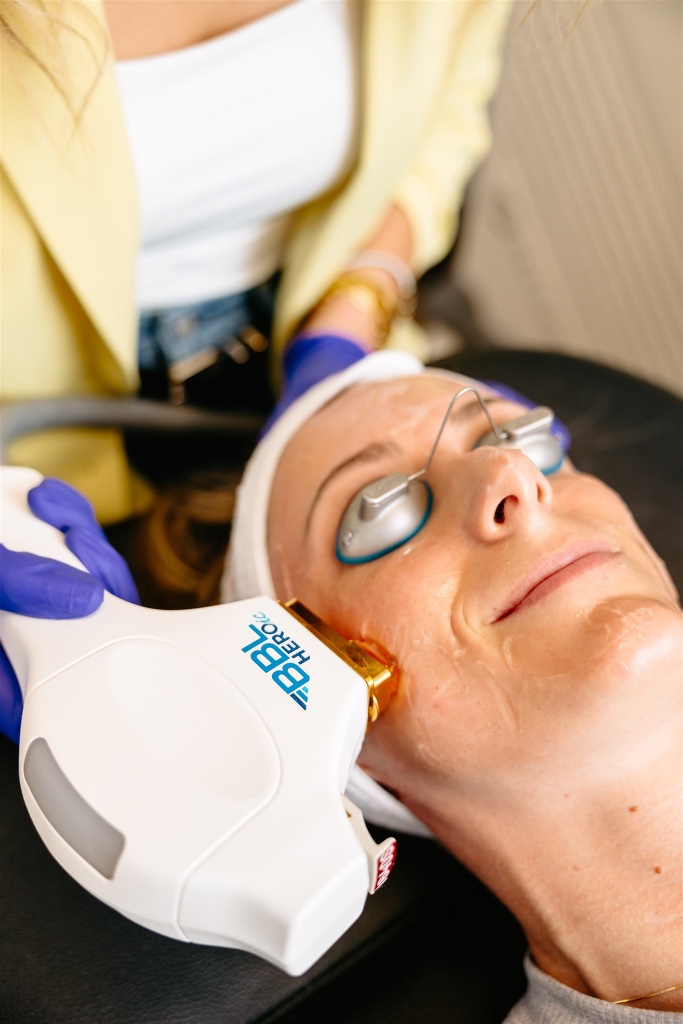
The best resurfacing decisions are built around the skin in front of us — not the device most recently added to the menu.
[AMY REVIEW REQUIRED]
Draft direction for Amy's perspective: "More technology doesn't automatically mean every patient needs a more aggressive treatment. What I like about having different resurfacing options is the ability to customize. The goal is to choose the treatment that makes sense for your skin and your goals rather than automatically choosing the newest or strongest option."
This draft has not been published as Amy's direct quote. It requires Amy's review and approval before publication.
Section 06
When HALO® may still be
the right resurfacing choice.
More specific, focused concerns
A patient whose primary goal is texture refinement and early line improvement — without significant dyschromia or multi-layer pigment irregularity — may be well-served by HALO's two-layer approach without needing the additional tone component.
Patients new to resurfacing
HALO can serve as an effective introduction to more significant resurfacing, helping patients build a baseline of skin health and recovery experience before considering a broader approach.
Annual maintenance resurfacing
Patients in a long-term maintenance strategy may find HALO's defined parameters and predictable recovery ideal for consistent annual correction.
Patients with downtime constraints
At conservative calibration settings, HALO can be tuned to a meaningful resurfacing outcome with a more manageable recovery timeline.
Concerns well within HALO's range
If the assessment reveals that HALO's established capabilities already cover what the patient wants to address, adding HALO TRIBRID's wavelength may offer no meaningful improvement.
Patients comfortable with the known track record
For some patients, the well-established clinical profile of HALO — its predictability, its documented outcomes, and the extensive provider experience surrounding it — is itself a meaningful reason to choose it.
Amy Robbins · Founder, Youthful Magnolia
"Simpler is not inferior. A well-calibrated HALO treatment for the right patient is not a compromise — it is clinical precision. The goal is always to do exactly what is needed, not everything that is possible."
Section 07
When HALO® TRIBRID™ may
make more sense.
Multi-layered, multi-concern presentations
Patients dealing simultaneously with rough texture, enlarged pores, early acne scarring, meaningful sun damage, dyschromia, and early fine lines may find that HALO TRIBRID addresses more of their full picture in one coordinated session.
Significant dyschromia or superficial sun damage
The 1927 nm MOXI wavelength in HALO TRIBRID specifically targets the superficial tone and pigment layer — making it particularly relevant where tone and discoloration concerns are meaningful alongside texture goals.
Patients stepping up from MOXI or standard HALO
Patients who have built a foundation through MOXI or HALO maintenance treatments and are ready for more comprehensive correction may find HALO TRIBRID a natural next step.
Patients wanting comprehensive annual correction
For patients who prefer one significant annual correction over multiple lighter treatments, HALO TRIBRID's multi-layer approach may address their full concern profile in a single treatment event.
Acne scar and texture alongside tone goals
When acne-related textural irregularities coexist with meaningful tone or pigment concerns, the multi-layer approach of HALO TRIBRID may address both more effectively than HALO alone.
Advanced cumulative sun exposure
In a Fort Worth climate, cumulative UV exposure accumulates across multiple skin layers. For patients whose sun damage is both superficial and structural, HALO TRIBRID's triple-layer approach may address more simultaneously.
Section 07b
Should I choose HALO
or HALO TRIBRID?
The decision should be based on what your skin needs — not simply which platform is newer. Treatment intensity, pigment concerns, texture, downtime tolerance, skin type, and overall goals all affect the treatment plan.
The factors that shape this decision include: the specific concerns you want to address (texture alone vs. texture plus tone plus pigment), the depth of those concerns across skin layers, your skin type and pigment-risk profile, how much downtime you can realistically accommodate, whether this is a first resurfacing treatment or part of a longer strategy, and what your long-term skin goals look like.
HALO may be the right choice when concerns are focused, when downtime needs to be manageable, or when a proven, predictable approach fits the goal. HALO TRIBRID may be the right choice when concerns span multiple layers, when tone and pigment are significant alongside texture, or when a more comprehensive single-session approach is desired.
The most reliable way to decide is a consultation with a provider who can evaluate your skin directly and build a plan around what they observe — not a device comparison article, including this one.
Section 08
Which concerns may push
the decision one way or the other.
A directional consultation guide only — a direct skin evaluation is always required before any recommendation.
Sun damage — early
HALO
HALO addresses surface and depth and may produce meaningful improvement in early sun damage.
HALO TRIBRID
The 1927 nm component adds a dedicated superficial tone layer. For early sun damage with tone irregularity, HALO TRIBRID may address the full picture more comprehensively.
Dyschromia / uneven tone
HALO
HALO can improve tone, though the tone layer is addressed secondarily through the two-wavelength approach.
HALO TRIBRID
The added 1927 nm wavelength directly targets superficial tone and dyschromia — a more specific mechanism for this concern alongside other goals.
Rough or uneven texture
HALO
HALO's ablative erbium component addresses surface texture directly — one of HALO's core strengths, and may not require the additional TRIBRID layer for texture alone.
HALO TRIBRID
Also effective for texture — if texture is the primary or sole concern, the additional wavelength may not add meaningful benefit over HALO.
Enlarged pores
HALO
HALO's dual-layer approach supports pore refinement through both surface renewal and collagen stimulation.
HALO TRIBRID
Similar pore refinement potential — the additional tone layer may also improve overall skin quality around pore areas where pigment is a co-concern.
Acne scars (shallow to moderate)
HALO
HALO can be effective for shallow acne scarring — ablative surface renewal combined with collagen stimulation addresses the textural component.
HALO TRIBRID
Adds the tone layer, which may support improvement in PIE or post-inflammatory pigmentation alongside the textural improvement.
Fine lines and early wrinkles
HALO
The 1470 nm non-ablative component in HALO directly targets the dermis for collagen renewal — HALO's strength for early aging.
HALO TRIBRID
Same depth component — may not significantly outperform HALO for isolated fine-line concerns if tone and pigment are not also meaningful goals.
Less intensive downtime preferred
HALO
HALO can be calibrated to lower-intensity settings with a more manageable recovery — more versatile across the maintenance-to-correction spectrum.
HALO TRIBRID
More difficult to dial to very conservative settings while preserving the benefit of all three wavelengths — generally suited to patients ready for a more significant session.
Multiple simultaneous concerns
HALO
HALO addresses a broad range well — but if the concern profile spans multiple layers deeply, there may be limits to what two wavelengths can cover in one session.
HALO TRIBRID
Designed for this scenario — multi-layer coordination in a single session may provide more comprehensive coverage when concerns span surface, tone, and depth simultaneously.
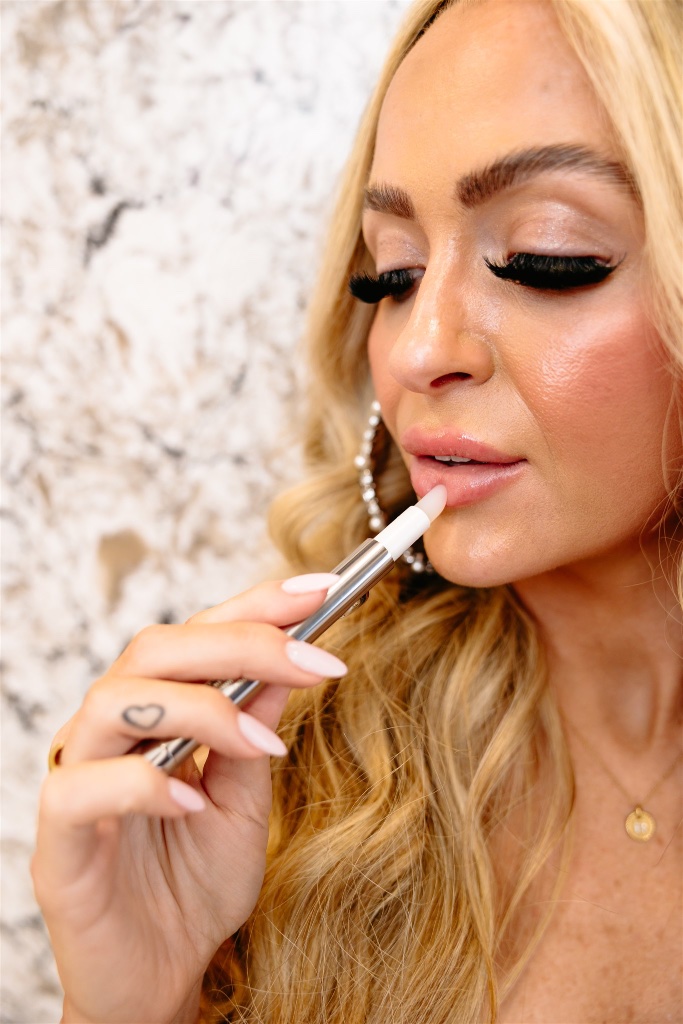
The resurfacing conversation starts with the skin — not the device. Every decision is shaped by what is actually present, not by what the brochure suggests.
Section 09
What a consultation at Youthful Magnolia
may include.
Direct skin evaluation
Amy evaluates the skin directly — texture, tone, pore quality, existing sun damage, scarring, Fitzpatrick classification, and baseline skin quality. What she observes shapes everything that follows.
Honest goal clarification
A clear conversation about what the patient wants to address — including naming what treatment can and cannot be expected to deliver in realistic terms.
Downtime and recovery assessment
How much recovery can the patient realistically manage? This is a primary variable in the treatment decision. Some patients's best treatment is not the most comprehensive one because they cannot commit to the recovery it requires.
HALO vs HALO TRIBRID vs other options
Amy compares HALO, HALO TRIBRID, MOXI, ProFractional, and other relevant Sciton platform options — explaining why each may or may not fit this specific patient's profile.
Personalized sequencing
Advanced resurfacing rarely happens in a single appointment. The consultation may include a phased plan — how to build toward the best long-term outcome over multiple sessions, starting from where the skin is today.
Honest expectations, not optimistic promises
The most important outcome of any consultation is that the patient leaves with an accurate understanding of what their treatment can realistically deliver — grounded in their anatomy, not in marketing language.
Section 09b
HALO TRIBRID at Youthful Magnolia
in Fort Worth.
At Youthful Magnolia in Fort Worth, every HALO TRIBRID conversation begins with a consultation — not a device selection. The process includes a direct skin assessment, individualized treatment planning, a realistic downtime discussion, aftercare guidance, and follow-up to monitor how the skin responds.
Amy Robbins leads every consultation personally, bringing deep Sciton platform expertise across HALO, MOXI, BBL, ProFractional, and HALO TRIBRID. The goal is not to recommend the newest device — it is to recommend the treatment that fits your skin, your goals, and your life.
Section 10
Why Fort Worth patients choose
Youthful Magnolia for resurfacing.
Amy Robbins evaluates every resurfacing patient personally — no delegated consultations
Deep Sciton platform expertise across HALO, MOXI, BBL, ProFractional, and HALO TRIBRID
Resurfacing is planned around the skin — not built around a device menu
Long-view strategy: sequencing, staging, and cumulative skin health
Honest communication about what each treatment can and cannot deliver
Regenerative philosophy — surface results supported by systemic skin health
Premium boutique experience in Fort Worth's most intentional aesthetics practice
Natural-looking results rooted in anatomical understanding, not aggressive over-treatment
Not sure which laser fits
your skin goals?
A consultation can help determine whether HALO TRIBRID, another resurfacing treatment, or a different approach makes the most sense for your skin, goals, and downtime preferences.
Common Questions
HALO TRIBRID vs HALO —
answered honestly.
What is the difference between HALO and HALO TRIBRID?
Is HALO TRIBRID better than HALO?
What does TRIBRID mean?
What wavelengths does HALO TRIBRID use?
What does HALO TRIBRID treat?
Does HALO TRIBRID have more downtime than HALO?
How long is HALO TRIBRID recovery?
When do HALO TRIBRID results appear?
How many HALO TRIBRID treatments do you need?
Is HALO TRIBRID painful?
Can HALO TRIBRID treat acne scars?
Can HALO TRIBRID treat sun damage?
Is HALO TRIBRID good for pigmentation?
Is HALO TRIBRID the same as MOXI?
What is the difference between HALO TRIBRID and XERF?
How do I know which laser is right for me?
Related Services
Laser Treatments
Explore the full Sciton-based laser menu at Youthful Magnolia.
HALO Laser
Hybrid fractional resurfacing — the two-wavelength Sciton standard.
Sciton TriBrid
The HALO TRIBRID triple-wavelength resurfacing platform.
MOXI
Non-ablative tone and early sun-damage resurfacing for all skin types.
ProFractional
Ablative fractional erbium for deeper correction and acne scars.
BBL
BroadBand Light for pigment, redness, and long-term skin maintenance.
Facials & Skin
Non-laser skin treatments to complement your resurfacing plan.
Book a Consultation
Begin with a personalized resurfacing evaluation from Amy Robbins.
Your Provider
Amy
Robbins
MSNA · APRN · CRNA · FNP-BC
Book a Consultation"Choosing between HALO and HALO TRIBRID is not about which sounds more advanced. It is about understanding your skin well enough to know which treatment actually fits — and having a provider who will tell you the truth."
— Amy Robbins, Founder · Youthful Magnolia
Youthful Magnolia · Fort Worth, TX
Ready to find out which resurfacing
treatment fits your skin best?
If you're comparing HALO TRIBRID and HALO in Fort Worth, our team can help you understand which option makes more sense for your skin, your goals, and your ideal recovery path.