RF Microneedling vs Laser Resurfacing in Fort Worth: Which Is Better for Texture, Scars, and Skin Tightening?
A strategic, medically grounded guide for Fort Worth patients navigating the choice between RF microneedling and laser resurfacing — for acne scars, skin texture, pores, and early tightening.
 Amy Robbins, MSNA APRN CRNA FNP-BC 18 min read June 2026Skin Resurfacing
The comparison between RF microneedling and laser resurfacing is one of the most common questions arriving in Fort Worth aesthetic consultations right now — and one of the least well-answered in most of what exists online.
Most comparisons treat this as a simple either-or: RF microneedling for skin tone concerns, laser for texture. RF for sensitive skin, laser for more dramatic results. These generalizations capture fragments of clinical truth while missing what actually determines the right recommendation: your specific skin, your specific concerns, and an honest conversation about what each approach can realistically deliver for you.
At Youthful Magnolia in Fort Worth, we approach both categories of treatment with the same philosophy: the technology matters far less than the thinking behind it. This article is designed to give you the context to approach your own decision with that same clarity.
We'll also be honest about what this article cannot do: tell you which treatment you specifically need. That answer requires a direct evaluation of your skin, your anatomy, your goals, and your recovery capacity. What this can do is make that consultation significantly more productive when you arrive for it.
Section 01
What RF microneedling generally does —
and how it works in the skin.
RF microneedling combines two distinct mechanisms. The first is mechanical: fine needles create micro-channels in the skin, triggering the wound-healing cascade that drives collagen induction — the same foundational mechanism as standard microneedling. The second is thermal: radiofrequency energy is delivered through the needle tips directly into the dermis at a defined depth, creating controlled thermal zones that stimulate a more pronounced collagen remodeling response.
The key clinical distinction is what the thermal component adds. Where standard microneedling relies primarily on mechanical injury, RF microneedling adds heat energy at depth. This thermal stimulation is associated with both collagen neogenesis (new collagen production) and collagen contraction — mechanisms that together contribute to improvements in skin texture, firmness, and structural support over time.
RF microneedling is particularly relevant in conversations about patients for whom surface-level treatments are not enough, but for whom ablative laser may carry a higher risk of unwanted effects — particularly patients with higher Fitzpatrick skin types. Because RF microneedling's energy is delivered sub-epidermally through needle channels, the surface layer is less exposed.
At Youthful Magnolia, standard microneedling and mesoneedling with skin boosters are well-established parts of the skin health toolkit. For patients whose goals extend toward more structural tightening or deeper dermal remodeling, advanced RF-based microneedling options may become part of the consultation conversation as our technology platform continues to evolve based on patient needs and treatment goals.
RF Microneedling — What the mechanism does
Mechanical
Micro-channel creation
Needles penetrate the dermis to defined depths, triggering the wound-healing cascade that signals fibroblasts to produce new collagen and elastin.
Thermal
RF energy at depth
Radiofrequency energy delivered through the needle tips creates controlled thermal zones in the dermis — stimulating collagen contraction and neogenesis.
Cumulative
Series-based improvement
Results develop over weeks to months as the collagen remodeling process matures. Most protocols involve multiple sessions spaced 4–6 weeks apart.
Section 02
What laser resurfacing generally does —
and why the spectrum matters.
Laser resurfacing is not a single treatment — it is a category that spans a wide range of approaches, from gentle non-ablative tone correction to more comprehensive surface renewal. Understanding where on this spectrum a given treatment sits is essential to any meaningful comparison with RF microneedling, because "laser" means very different things depending on the device and parameters involved.
At the gentler end, non-ablative lasers like MOXI work without removing the skin's outer layer — delivering targeted wavelength energy into the dermis to stimulate collagen and address tone, early sun damage, and radiance. Downtime is minimal.
Hybrid fractional lasers like HALO and Sciton TriBrid combine ablative and non-ablative wavelengths in a single coordinated pass — addressing both the surface and the dermis simultaneously. This dual approach allows meaningful results across multiple concerns in a single treatment session with a defined recovery period.
The practical point: when evaluating laser resurfacing against RF microneedling, you are not comparing one thing against one other thing. You are comparing a spectrum of mechanisms, depths, downtime profiles, and patient-fit considerations. The right comparison is always specific — which laser approach versus which RF-based approach for this patient, this concern, this recovery window?
The laser resurfacing spectrum at Youthful Magnolia
MOXI
Gentle entryEarly tone, radiance, sun-damage prevention, maintenance resurfacing
Downtime
Minimal to none
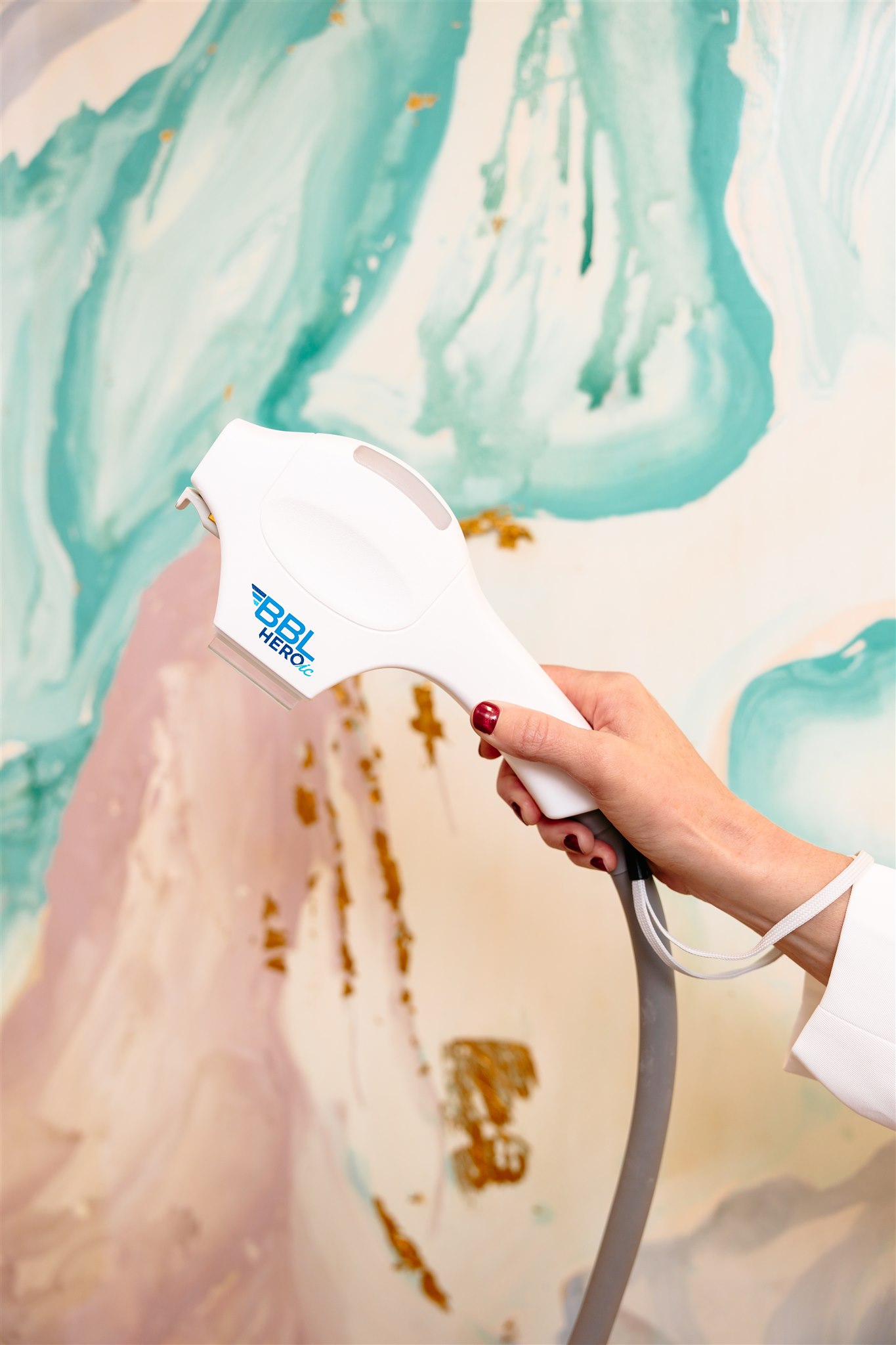
BBL BroadBand Light
Surface tonePigment, redness, vascular, long-term skin maintenance
Downtime
7–10 days pigment clearing
HALO Hybrid Fractional
Moderate resurfacingTexture, tone, pores, early aging, overall skin quality renewal
Downtime
5–7 days
Sciton TriBrid
Comprehensive resurfacingMulti-layer concerns across tone, texture, and structural renewal
Downtime
5–10 days
Section 03
Acne scars, pores, texture, and tightening —
how the conversation changes.
The reason this comparison matters is that the four concern categories most commonly driving the question — acne scars, enlarged pores, rough texture, and skin tightening — each have their own clinical drivers. They are not the same concern wearing different names, and they are not all solved by the same treatment logic.
Acne scars
Acne scarring is a structural concern. Pitted, rolling, boxcar, or icepick scars represent actual tissue changes in the dermis — depressions created by the inflammatory destruction of collagen and fat during the active acne cycle. Addressing them requires treatment that reaches the dermis with enough energy or mechanical stimulus to remodel that structural deficit. Ablative fractional laser — particularly ProFractional — is often discussed for more significant acne scar depths. For shallower textural scarring, HALO's hybrid approach may address the surface texture component alongside collagen stimulation. RF microneedling may be relevant for patients whose skin tone makes ablative laser a higher-risk option, or for patients who want collagen remodeling with a different recovery profile. For some patients, energy-based microneedling options may become part of the conversation during consultation.
Enlarged pores
Enlarged pores reflect sebaceous gland size, collagen support around the pore structure, and surface skin quality. Both laser resurfacing and RF microneedling can be relevant here, through somewhat different mechanisms. Laser resurfacing's surface renewal component may produce more immediate improvement; RF microneedling's collagen stimulation produces change over a longer timeline as new collagen fills in around pore structures.
Rough or uneven texture
Skin texture irregularities — from sun damage, post-acne changes, or aging — live largely at the surface and in the upper dermis. Ablative laser resurfacing's surface renewal mechanism is particularly efficient here: physically removing the outer skin layer triggers a renewal response that can produce meaningful texture improvement. Non-ablative options including MOXI and RF microneedling can also improve texture, but through more gradual collagen remodeling rather than direct surface removal.
Skin tightening
Tightening is a different category from resurfacing. Mild to moderate skin laxity involves changes in collagen density, elastin quality, and overall tissue support. RF microneedling's thermal component contributes to both collagen contraction and neogenesis, which can produce gradual tightening improvement in the right patient profile. Laser resurfacing drives collagen stimulation through wound healing, but without the same direct thermal tissue-contraction mechanism. For more significant laxity, focused ultrasound or surgical consultation may be more relevant than either resurfacing category.

The treatment decision starts with understanding what is actually driving the concern — not with selecting from a menu of device names.
Section 04
RF microneedling vs laser resurfacing —
side by side.
A directional clinical comparison. Individual results, patient fit, and treatment planning require a direct consultation.
Primary mechanism
RF Microneedling
Mechanical collagen induction (micro-channels) + thermal dermal stimulation via RF energy through needle tips. Collagen remodeling develops over weeks to months.
Laser Resurfacing
Wavelength-specific energy delivery — ablative (surface removal + wound healing), non-ablative (dermal stimulation), or hybrid combinations of both in one session.
Clinical context
RF works sub-epidermally through needle channels. Laser energy interacts with the skin across wavelength-specific depths and targets.
Surface renewal
RF Microneedling
Limited direct surface renewal. Micro-channels heal quickly; the visible skin surface is largely preserved. Surface improvement comes indirectly via collagen remodeling.
Laser Resurfacing
Ablative laser directly removes and renews the outer skin layer. Hybrid fractional lasers combine surface renewal with depth — a more direct mechanism for surface-level texture.
Clinical context
For patients whose primary goal is surface texture improvement, the ablative component of laser may produce more direct results.
Skin tightening
RF Microneedling
RF thermal energy triggers collagen contraction alongside neogenesis — a mechanism more directly associated with tissue firming. A stronger story for mild to moderate laxity.
Laser Resurfacing
Collagen stimulation from laser resurfacing contributes to gradual firmness improvement. Not primarily a tightening mechanism — more appropriate for texture and quality improvement.
Clinical context
If tightening is the primary goal, RF-based approaches are typically more directly targeted than resurfacing laser.
Acne scar improvement
RF Microneedling
Relevant for shallower textural scarring and for patients with higher Fitzpatrick types. Multiple sessions build cumulative collagen to fill and smooth depressed scar tissue gradually.
Laser Resurfacing
Fractional ablative laser (ProFractional) is often the most aggressive non-surgical approach for significant acne scar correction. HALO may address shallower textural scars effectively.
Clinical context
Scar type and depth matter significantly. Ice-pick and deep boxcar scars may require more aggressive approaches. A consultation is essential.
Fitzpatrick skin type considerations
RF Microneedling
Generally better tolerated across higher Fitzpatrick types due to sub-epidermal energy delivery. Reduced risk of post-inflammatory hyperpigmentation compared to ablative laser.
Laser Resurfacing
Fitzpatrick type is a critical variable. Non-ablative laser (MOXI) and properly calibrated hybrid lasers can be used in higher skin types, but ablative settings require careful consideration.
Clinical context
This is a clinically significant distinction for patients with skin of color or higher Fitzpatrick classification.
Typical downtime
RF Microneedling
24–72 hours redness and mild swelling in most cases. Social downtime is limited. Significant visible healing is not typical after most RF microneedling sessions.
Laser Resurfacing
Ranges widely: MOXI = minimal to none. HALO = 5–7 days. ProFractional = 5–10+ days depending on depth. Parameters are the primary downtime driver.
Clinical context
Downtime is always a function of treatment intensity and individual biology — not just device category.
Sessions typically needed
RF Microneedling
Series-based: 3–4 sessions spaced 4–6 weeks apart is a common protocol. Results build cumulatively. Maintenance sessions typically follow.
Laser Resurfacing
Varies by treatment. HALO can produce meaningful results from a single well-calibrated session. MOXI is often done as a series. ProFractional depends on scar depth and goals.
Clinical context
The appropriate number of sessions is patient and concern specific — confirmed during consultation.
Section 05
Amy Robbins on this comparison —
what she actually wants patients to know.
Most of what I encounter in consultations around this comparison is a version of the same question: "Which one is better?" And I understand why patients ask it that way — it's the simplest framing, and it implies there's a clean answer. There isn't. But there is a better question, and it leads to a much more productive conversation.
The better question is: for your skin, your concerns, your recovery tolerance, and your goals right now — which mechanism is more likely to deliver meaningful improvement in a way you can realistically sustain? That question has an answer. It's just not the same answer for every patient.
What I see most often: patients with a mix of concerns — some texture, some early acne-related changes, some interest in a firmer, more supported look to the skin — who genuinely benefit from understanding which part of their concern profile points in which direction. Texture and surface renewal are often better addressed by ablative laser mechanisms. Tightening and gradual dermal remodeling may favor RF-based thermal energy. Skin-of-color patients may have a clearer path through RF-based approaches for certain concerns where ablative laser carries more risk.
I also want to be honest about what has changed in this space. Treatment platforms for RF-based microneedling continue to evolve, and for some patients, advanced RF-based treatment options may become part of the conversation during their consultation as our technology platform continues to expand. What doesn't change is the approach: understanding what the skin actually needs before deciding which tool to use.
"The patients who get the best outcomes are the ones who come in asking about their skin — not about a device. When someone says 'I want to understand my options for the texture on my cheeks,' that's a conversation I can build a real plan around. When someone says 'I want the RF microneedling,' I always start by asking why — and the answer usually reveals that what they actually want is the outcome, not the tool."
Amy Robbins
MSNA · APRN · CRNA · FNP-BC · Founder, Youthful Magnolia
Section 06
When RF microneedling may
make more sense for your skin.
Higher Fitzpatrick skin types
For patients with skin tones where ablative laser carries a higher risk of post-inflammatory hyperpigmentation, RF microneedling's sub-epidermal energy delivery may offer a more appropriate mechanism for collagen stimulation and texture improvement.
Tightening as a primary goal
When mild to moderate skin laxity — in the lower face, perioral area, or neck — is the central concern, RF's thermal collagen-contraction mechanism may be more directly relevant than resurfacing laser's wound-healing pathway.
Minimal downtime is essential
RF microneedling typically involves 24–72 hours of redness and swelling, with minimal visible healing beyond that window. For patients whose schedule does not allow for a laser resurfacing recovery arc, this profile may be more sustainable.
Texture with tightening goals together
When a patient has both texture concerns and interest in gradual tissue firming, RF microneedling's dual mechanism — collagen remodeling plus thermal contraction — may address both directions without requiring the more significant downtime of ablative resurfacing.
Collagen support as a long-term foundation
For patients building a preventive, maintenance-oriented approach to skin health, the cumulative collagen-building effect of a treatment series supports skin quality in a way that fits naturally into ongoing care.
Patients exploring advanced RF-based options
For some patients, advanced RF-based microneedling options may become part of the consultation conversation — particularly where goals include more comprehensive dermal remodeling. Our platform continues to evolve based on patient needs.
Amy Robbins · Founder, Youthful Magnolia
"Tightening and resurfacing are not the same goal. RF energy's thermal collagen contraction is a fundamentally different story from a laser's wound-healing response — and for the patient whose skin is telling a tightening story, that difference matters enormously."
Section 07
When laser resurfacing may
be the better-fit conversation.
Surface texture is the primary concern
When rough, uneven surface texture — from sun damage, skin aging, or post-acne changes — is the dominant goal, the ablative component of laser resurfacing offers a more direct mechanism: physically renewing the surface layer and triggering a wound-healing response that reshapes the outer skin.
Tone and pigment alongside texture
Laser platforms like HALO and Sciton TriBrid are specifically designed to address tone, pigment, and texture in a coordinated session. For patients with both surface irregularities and meaningful discoloration or dyschromia, the multi-wavelength approach may provide more comprehensive coverage.
Deeper acne scar correction
For significant acne scarring — particularly boxcar, rolling, or distributed shallow scars — fractional ablative laser such as ProFractional may provide a more robust corrective mechanism, reaching the depths of structural scar tissue more directly.
Patients who can commit to recovery
Laser resurfacing delivers more comprehensive results in fewer sessions for many patients, at the cost of a defined recovery window. For patients who can plan that window and want the most meaningful improvement per session, the laser pathway may be more efficient.
Early sun damage and photoaging maintenance
MOXI and the BBL platform offer an evidence-supported pathway to long-term skin health maintenance through consistent, low-downtime laser treatment. For patients prioritizing proactive maintenance, this is a meaningful part of the conversation.
Broad skin quality renewal as the goal
When a patient wants comprehensive skin quality improvement — overall renewal of texture, tone, pore quality, and radiance — the multi-layer hybrid laser approach may deliver more of that picture in a single planned treatment than a microneedling series.
The right resurfacing conversation begins with the skin in front of us — the device follows the finding, not the other way around.
Section 08
What a consultation at Youthful Magnolia
may include.
No treatment plan at Youthful Magnolia begins with a device recommendation. It begins with an evaluation of the skin in front of us.
Direct skin evaluation by Amy Robbins
Every new patient consultation begins with Amy reviewing the skin personally — texture, tone, pore quality, laxity, Fitzpatrick type, existing sun damage, and acne-related changes. What she observes determines everything that follows.
Concern prioritization
A clear conversation about which concerns matter most to you, which are primary versus secondary, and what your skin is telling the same story about. Multiple concerns often have a single most-important anchor — identifying it shapes the treatment direction.
Mechanism matching
Amy explains which treatment mechanisms are most relevant for your specific concern profile — and why. This includes an honest discussion of what RF-based approaches and laser resurfacing may and may not deliver for your specific goals.
Fitzpatrick and safety considerations
Your skin type is a primary variable in the conversation — particularly for ablative laser. The right treatment for one patient's texture concerns may not be appropriate for another's. Safety is built into the recommendation, not treated as an afterthought.
Recovery and life fit
How much downtime can you realistically plan for? This directly determines which treatments are appropriate, and whether a series-based approach or a single more intensive treatment better fits your life.
Technology context and future planning
As treatment technologies evolve, advanced RF-based treatment options may be discussed during consultation where they are clinically appropriate. Treatment planning at Youthful Magnolia is a long-term conversation — not a single-session decision.
Section 09
Why Fort Worth patients choose
Youthful Magnolia for skin resurfacing.
Amy Robbins personally evaluates every new patient — no delegated consultations
Deep Sciton platform expertise across MOXI, BBL, HALO, TriBrid, and ProFractional
Honest, unhurried conversations about what each treatment can and cannot deliver
Fitzpatrick-aware treatment planning — safety is built into every recommendation
Long-term skin strategy — not a single-session transaction
Treatment plans built around anatomy and biology, not device popularity
A technology platform that continues to expand based on patient needs and goals
Premium boutique experience in Fort Worth's most intentional aesthetics practice
Common Questions
RF microneedling vs laser resurfacing —
answered honestly.
What is RF microneedling and how does it differ from regular microneedling?
Is RF microneedling better than laser resurfacing for acne scars?
Does RF microneedling tighten skin?
What does laser resurfacing do for texture and pores?
Can RF microneedling and laser resurfacing be combined?
Is RF microneedling safe for darker skin tones?
How many sessions of RF microneedling are typically needed?
What is the downtime difference between RF microneedling and laser resurfacing?
Do I need RF microneedling or laser resurfacing for large pores?
Where can I have RF microneedling or laser resurfacing in Fort Worth?
Related Services
Laser Treatments
Explore the full Sciton-based laser menu at Youthful Magnolia — MOXI, BBL, HALO, TriBrid, and more.
HALO Hybrid Fractional Laser
Dual-wavelength hybrid resurfacing for texture, tone, pores, and early aging.
Sciton TriBrid
Triple-wavelength resurfacing for comprehensive multi-layer skin renewal.
MOXI
Non-ablative 1927nm laser for tone correction and early sun damage — minimal to no downtime.
Microneedling
Collagen induction therapy for texture, pores, and skin quality — with zero laser downtime.
Mesoneedling & Skin Boosters
Hyaluronic acid and active infusion for deep hydration, radiance, and skin quality support.
Facials & Skin Treatments
The full range of non-laser skin treatments at Youthful Magnolia.
Book a Consultation
Begin with a direct skin evaluation from Amy Robbins — the only real starting point for any resurfacing conversation.
Your Provider
Amy
Robbins
MSNA · APRN · CRNA · FNP-BC
Book a Consultation"RF microneedling and laser resurfacing are both real answers — to different questions. My job is to figure out which question your skin is actually asking."
— Amy Robbins, Founder · Youthful Magnolia
Youthful Magnolia · Fort Worth, TX
Ready to find out which approach
actually fits your skin?
If you're comparing RF microneedling and laser resurfacing options in Fort Worth, our team can help you understand which conversation actually applies to your skin — and build a plan around what we find, not what's trending.